In brief
- Geotextile must be included in the system for a defined function.
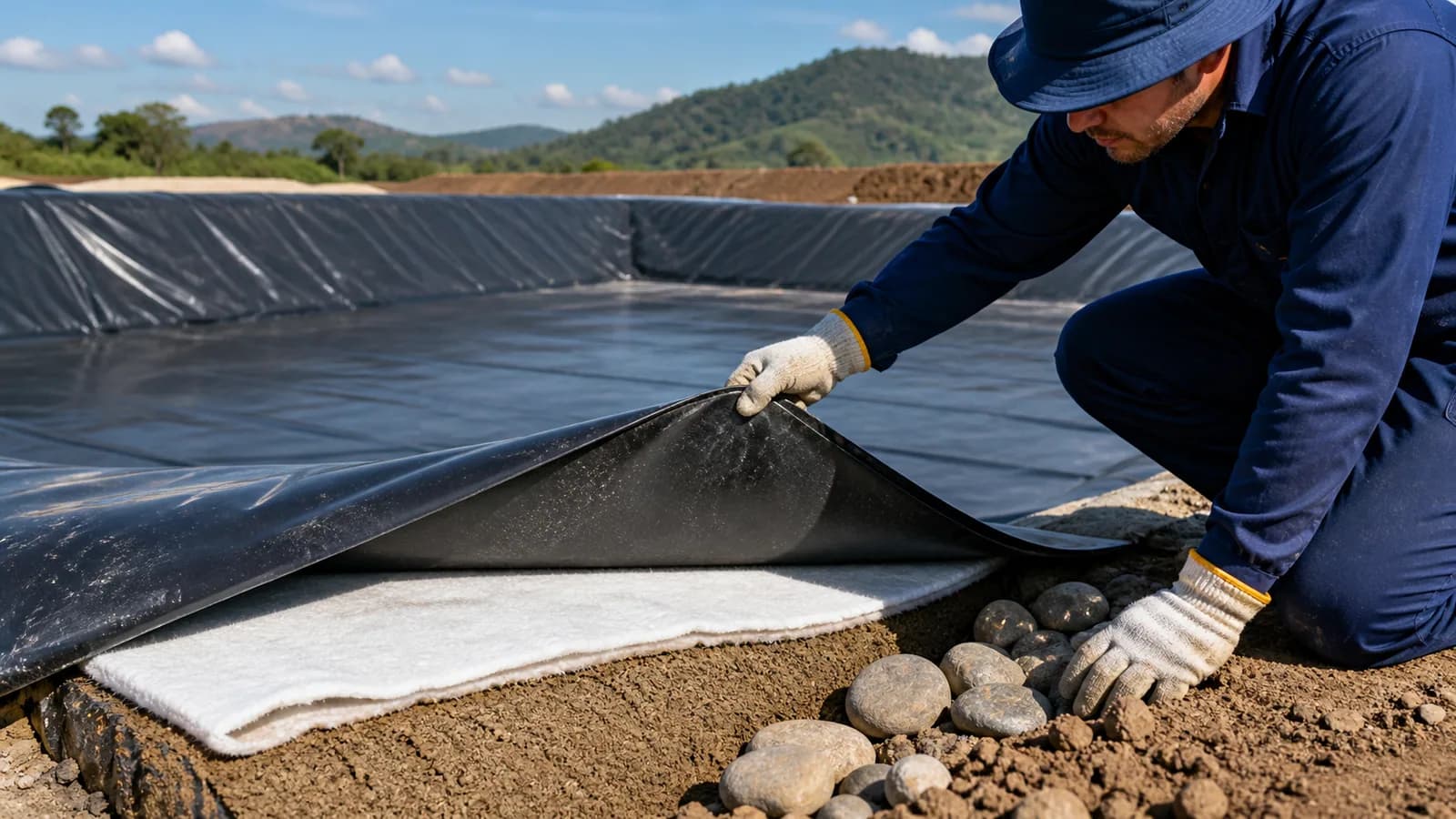
- Under a geomembrane, it can protect against puncture and abrasion.
- Over a geomembrane, it can protect against aggregate, soil, or operating activities.
- Mass per unit area alone does not demonstrate protection, filtration, drainage, or stability.
Placing “a white fabric underneath” has become a common recommendation. However, geotextile is not a generic accessory. Depending on its position and the design, it can perform very different functions—and a product suitable for separation is not automatically the best puncture protection.
The first question is: protection against what?
Under the geomembrane, geotextile can provide cushioning against angular particles, small irregularities, and concentrated stresses. The assessment considers particle shape and size, applied stress, support quality, and the combined behavior of all layers.
This does not justify installation over roots, metal, large stones, voids, or soft areas. The subgrade must be prepared and accepted; geotextile is part of the protection, not permission to conceal defects.
Under, over, or beside a drain?
| Position | Possible function | Question that must be answered |
|---|---|---|
| Under the geomembrane | protection/cushioning | Which particles and stresses can reach the sheet? |
| Over the geomembrane | protection | Which soil, aggregate, equipment, or cleaning activity will contact the system? |
| Beside a drain | filtration | Does the fabric retain soil and allow flow without clogging? |
| Between materials | separation | Does it prevent mixing without obstructing hydraulic performance? |
| On a slope | interface | Is the interface shear strength sufficient under actual conditions? |
The same project may require more than one of these functions. This does not mean the same product should be used in every position.
Why “how many grams?” is not enough
Mass per unit area in g/m² is easy to compare, but by itself it does not describe thickness under load, puncture resistance, filtration opening size, permittivity, or interface friction. Two geotextiles with the same mass per unit area may behave differently.
When puncture consequences are significant, protection can be verified through a representative system test. The international GRI-GS11 guide, for example, addresses test-pad construction for evaluating protective materials. The practical lesson is simple: protection is demonstrated by the combination of layers; it cannot be presumed from the color or weight of the roll.
Four errors that create false confidence
- choosing only the highest available mass per unit area;
- covering a rejected base and proceeding with installation;
- claiming that the geotextile “drains” without a flow path and outlet;
- introducing a new slope interface without checking its stability.
For applications with aggregate over the liner, the placement method also matters. Equipment and concentrated dumping can cause damage even when a protective layer has been specified.
Specification checklist
Before purchasing, record position, function, adjacent material, particle size and angularity, expected stress, wet condition, flow to be filtered or drained, slope, installation method, traffic, and acceptance criteria.
These data support the evaluation of system-layer supply and planning for geomembrane installation, without treating geotextile as an automatic solution.
Technical references
- USDA-NRCS — Pond Sealing or Lining, CPS 521
- GRI-GS11 — puncture protection
- U.S. EPA — QA/QC for Waste Containment Facilities
International references support design reasoning, but project requirements must be confirmed for the Brazilian context and the applicable specification.