Selecting cistern capacity only from the available area or a “standard” volume can create two opposite problems: a reserve too small for the critical period or a structure larger than the collection system can supply.
Sizing begins when three pieces of information enter the same calculation: how much water the operation needs, how much rain can provide, and how long the reserve must sustain use. Ground, roof, filtration, piping, and maintenance then complete the system.
This guide organizes the data needed to begin an assessment of cistern construction and lining.
1. Define how the water will be used
The first question is not “how many liters fit?” but “which uses will be served?” Irrigation, facility washing, animal watering, production processes, and human consumption have different requirements for quality, treatment, hydraulic separation, and health protection.
ABNT NBR 15527:2019 covers the use of roof rainwater for non-potable purposes in Brazil. If there is potable use or contact requiring another water quality, the design must assess specific laws, treatment, monitoring, and responsibilities. Storing water does not automatically make it safe to drink.
Brazilian Law 14,546/2023, in the context of changes to federal sanitation legislation, requires the rainwater network and tank to be separate from the public network and the water to receive treatment compatible with safe use. For human consumption, Ordinance GM/MS 888/2021 establishes control, surveillance, and potability procedures applicable to water-supply solutions. The purpose of the water therefore changes the design and its controls.
To establish demand, record:
- every point of use that will receive cistern water;
- average daily consumption or consumption per production cycle;
- demand peaks and seasonality;
- operating days per month;
- alternative sources available during drought;
- minimum volume that must remain as an operating reserve;
- planned expansion of the farm or facility.
Separating average and peak demand is important. A farm may have relatively stable consumption through a production cycle while concentrating washing on certain days. The cistern and pumping system must respond to actual behavior, not only an annual average.
2. Estimate the water that can be harvested
An initial estimate relates precipitation, collection area, and system losses:
potential volume = precipitation × collection area × runoff coefficient
When precipitation is measured in millimeters and area in square meters, one millimeter over one square meter theoretically corresponds to one liter. The coefficient reduces this total to represent losses on the roof, in gutters, in first-flush diversion, through leaks, and during the rainfall event itself.
This calculation is a screening tool, not complete sizing. The Funasa Sanitation Manual presents the same relationship in a teaching example and considers demand during the dry period. For a real design, values must be replaced with local data and expected performance of the selected components.
The Brazilian National Water and Basic Sanitation Agency maintains historical rainfall-station series in Hidroweb. A long, representative series is more useful than rainfall from a single year. Distance, altitude, gaps, and consistency of the selected station must also be checked; conditions in a neighboring city may not represent the farm microclimate.
3. Size through a balance of inflows and outflows
The annual total may appear sufficient while water is still unavailable at the most important time. This occurs because rainfall and consumption do not arrive at the same rate.
The balance should be calculated monthly or, when the design requires it, at shorter intervals:
- estimate collection for each period;
- subtract diversion and losses;
- subtract demand for the same period;
- carry the balance into the next period;
- limit the balance to the physical storage capacity;
- observe when overflow and deficit occur.
A sequence of dry months often controls the reserve more than annual precipitation. The practical question is therefore: which volume reduces the deficit to an acceptable level for this operation? The answer may combine a cistern, reduced consumption, a supplementary source, and a priority rule during drought.
There is no guaranteed autonomy without a climate assumption. If drought exceeds the scenario used, the reserve may end earlier than predicted. The design must clearly state the analyzed period and contingency plan.
4. Do not count the entire roof area without checking the water path
Horizontal roof projection is the starting point, but only the area that actually conveys water to the system belongs in the calculation. Roofs with multiple slopes, undersized gutters, disconnected sections, and elevation differences may reduce contribution.
Before finalizing volume, check:
- roof material and condition;
- area effectively connected;
- drainage direction and number of downpipes;
- gutter capacity during more intense events;
- leaves, dust, bird droppings, and other contamination sources;
- cleaning access;
- safe location for diversion and overflow.
The collection system is part of the project. A large cistern connected to only a few gutters still receives little water.
5. Provide first-flush diversion, filtration, and overflow
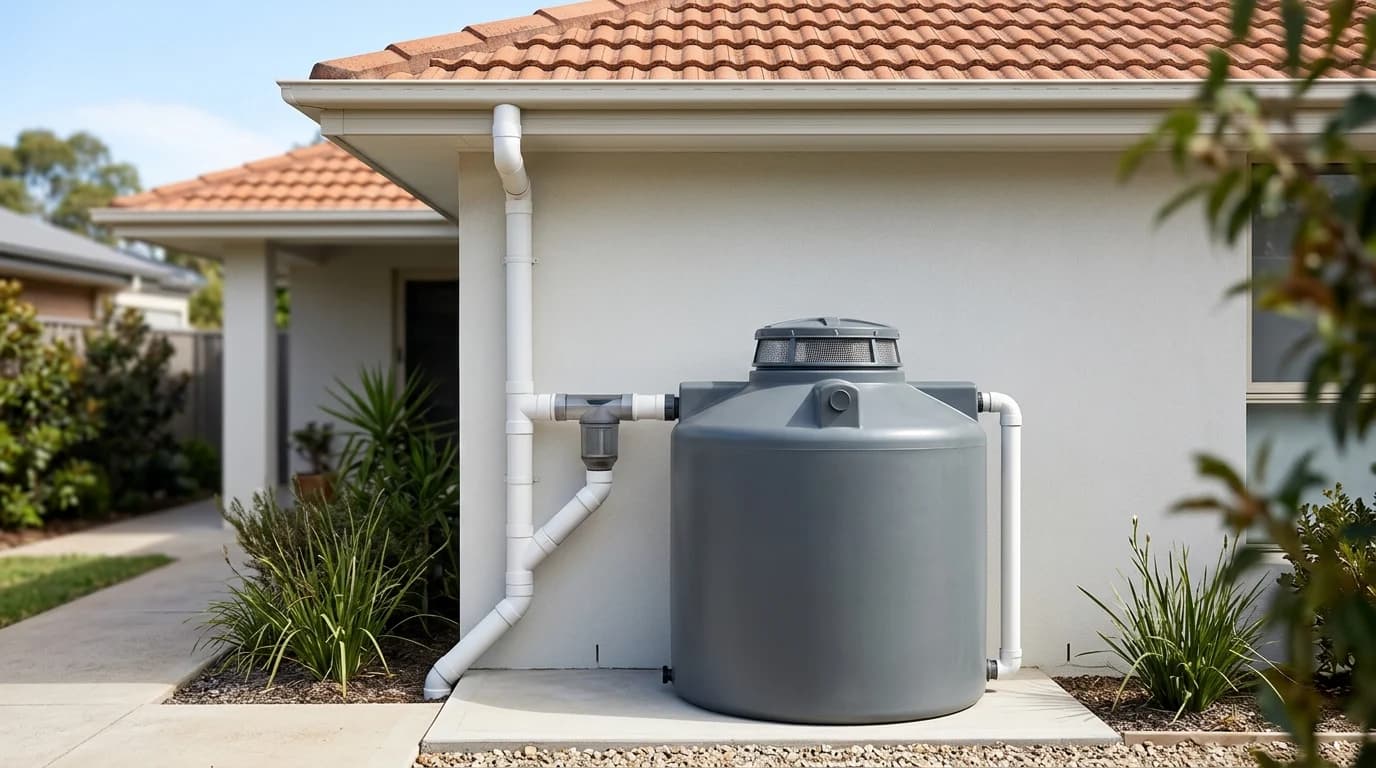
The first runoff from an event may carry dirt accumulated on the roof. Codevasf describes cistern systems with first-flush diversion, and the Funasa Manual also identifies initial diversion as a measure to protect stored water.
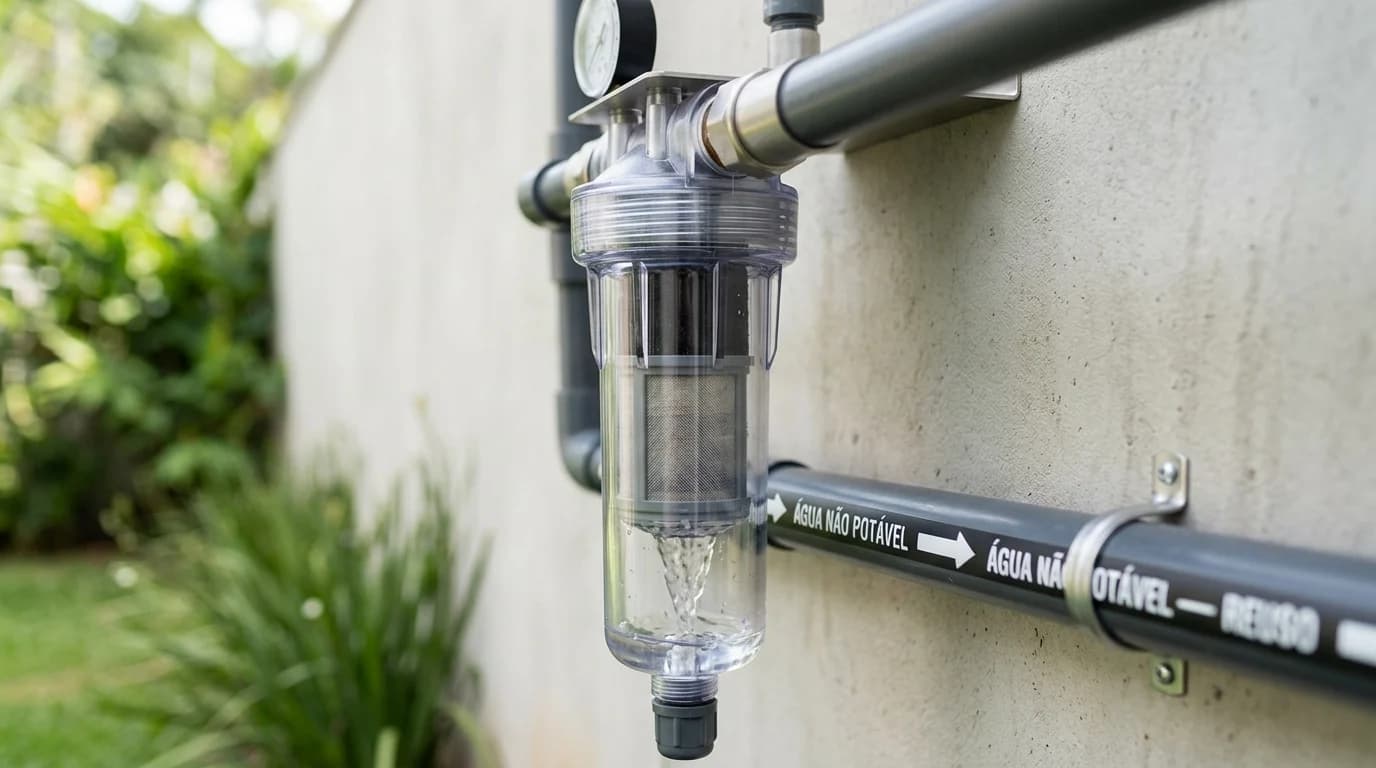
The method and diversion volume must not be copied from another project without assessing area, water use, rain frequency, and roof exposure. After diversion, screens, grates, or filters can retain solids before water enters the cistern.
Excess water must also be conveyed when the tank is full. The overflow must discharge where it will not cause erosion, slope instability, return flow into the cistern, or flooding of facilities.
6. Check ground, geometry, and groundwater
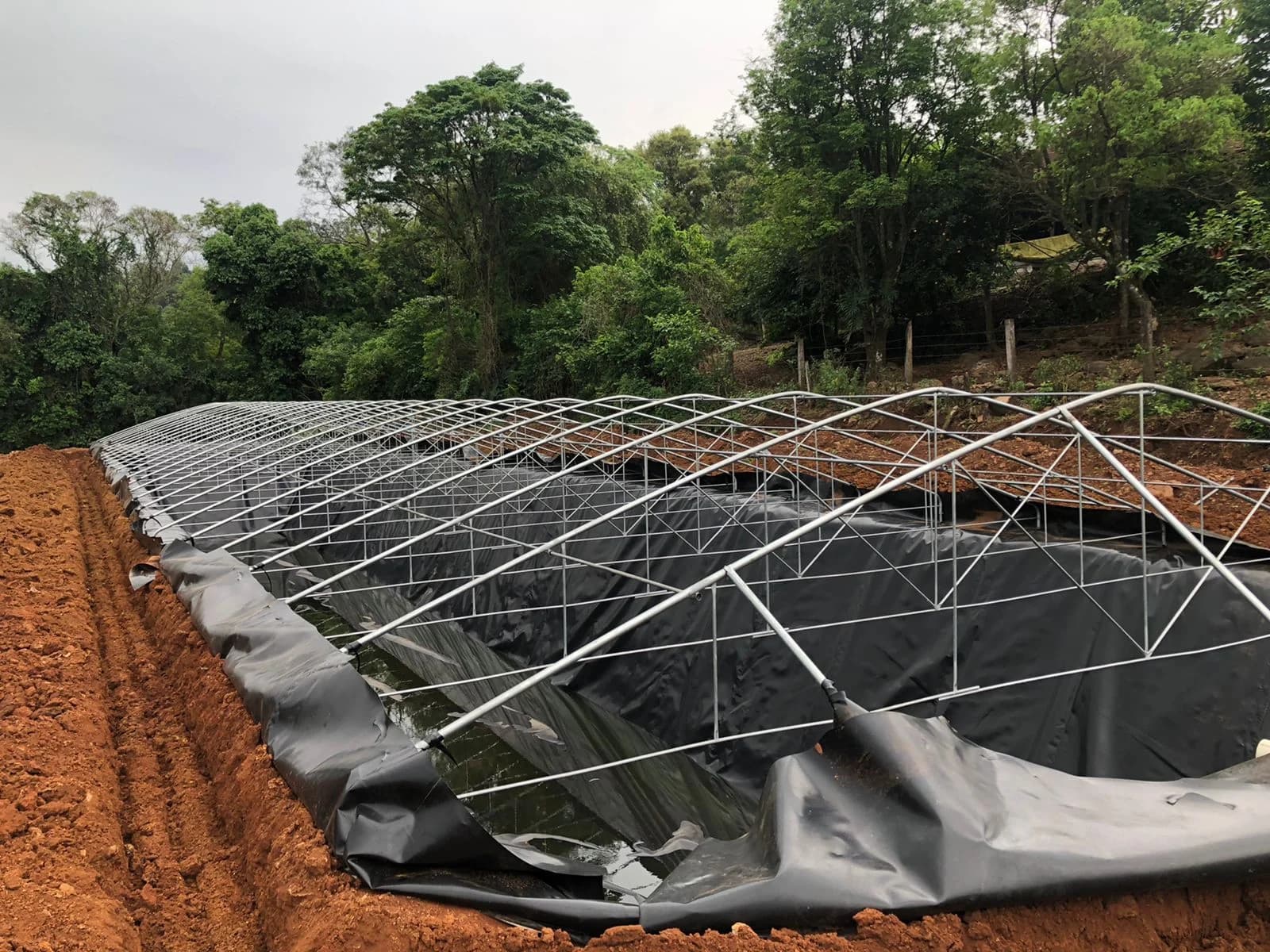
For a geomembrane-lined cistern, capacity depends on buildable geometry, not only desired volume. Depth, slope inclination, freeboard, access, anchoring, excavation, and earth movement must be compatible with the site.
The survey should examine:
- soil type and bearing capacity;
- stability of cuts and fills;
- presence of rock, organic soil, or sharp material;
- groundwater level and potential pressure beneath the liner;
- surface-water drainage around the structure;
- access for machinery, installation, and maintenance;
- safe distance from contamination sources and other structures;
- destination of excavated material.
A deeper cistern occupies less area but may increase excavation, stability, access, and drainage complexity. A shallower cistern occupies more land and increases cover area. Geometry is a joint decision involving capacity, safety, and construction.
7. Treat the liner and cover as performance components
The liner must be defined from the stored water, base, geometry, exposure, and operation. Smooth HDPE geomembrane is an engineered option, but material, thickness, protection, anchoring, welding, and quality control must form a specification.
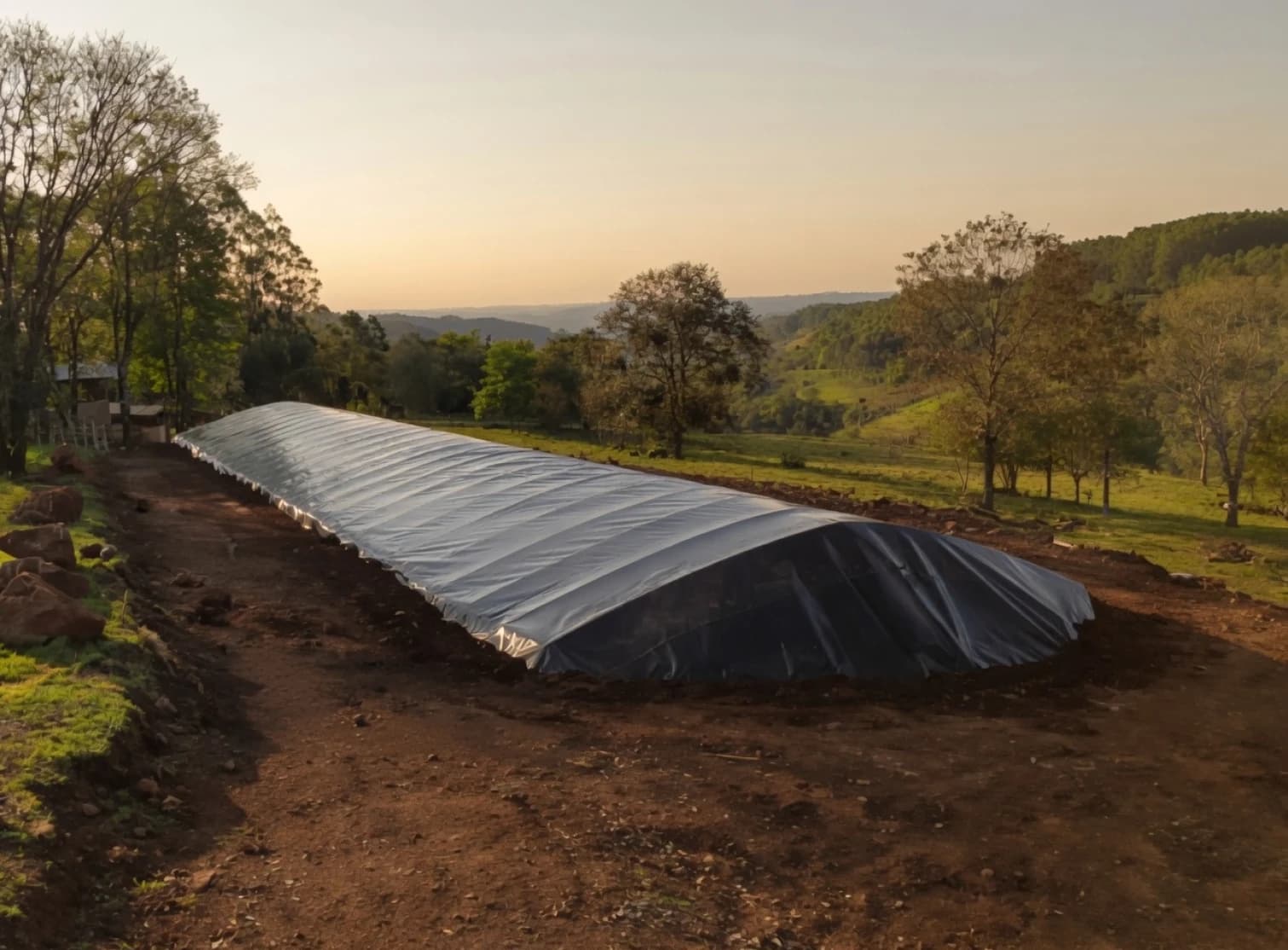
The cover helps reduce dirt entry, animal access, light exposure, and accidents. It must also withstand local wind, rain, and site conditions without transferring inappropriate forces to the liner or preventing inspections.
The inlet, withdrawal point, drain, overflow, pump, and piping must be detailed before installation. Improvised penetrations and interfaces are avoidable risk points.
8. Size water withdrawal as well
Storing water without delivering the required flow and pressure limits its use. Pump and piping selection must consider:
- peak flow;
- elevation difference;
- distance to points of use;
- head losses;
- water quality and solids content;
- power source and electrical protection;
- redundancy required by the operation.
Cistern volume and pumping capacity solve different problems. Both must match consumption.
9. Plan inspection and cleaning from the design stage
Gutters, filters, first-flush devices, cover, overflow, pump, and hydraulic points require access. The routine must provide inspection after intense events, removal of solids, leak checks, and water-quality care appropriate to the use.
The design must also prevent cross-connections between rainwater and potable-water networks. Identifying pipes and points of use reduces misuse risk.
Initial-assessment checklist
Before requesting sizing, gather:
- property location;
- intended water uses;
- average consumption, peaks, and months of greatest demand;
- desired autonomy period;
- roof areas and materials;
- sketch of the path between roofs and cistern;
- available local rainfall data;
- photographs and approximate ground dimensions;
- soil condition and groundwater information;
- distance and elevation to points of use;
- alternative source for critical periods;
- construction, schedule, and operating constraints.
With these data, analysis and sizing can compare demand, collection, capacity, geometry, and components before construction is mobilized.
The best volume is the one that closes the system
A well-planned cistern is not simply the largest one that fits on the site. It is the reserve that balances available water, priority demand, climate risk, budget, operation, and expansion potential.
If you plan to harvest rainwater or create a strategic reserve, LJS can organize the survey, define the scope, and assess cistern construction and lining for site conditions.
Technical references
- Brazil — Law 14,546/2023 on rainwater use
- Brazilian Ministry of Health — Ordinance GM/MS 888/2021
- ABNT NBR 15527:2019 — Use of roof rainwater for non-potable purposes
- Brazilian National Water and Basic Sanitation Agency — Hidroweb historical series
- Embrapa — rainwater harvesting and cistern storage for animal production
- Funasa — Sanitation Manual, water-supply chapter
- Codevasf — cistern systems
These references support general planning criteria. They do not replace the complete standard, design, local health and environmental requirements, or assessment by a qualified professional.