In brief
- A falling water level may result from evaporation, piping, a valve, withdrawal, or an overflow—not only from the liner.
- The locating method depends on whether the geomembrane is exposed, covered, or submerged.
- A permanent repair requires compatible material, surface preparation, equipment, and procedures.
- Every repair must be identified, documented, and retested.
A pond that is losing level requires a quick response, but the first step is not to apply a patch. Without confirming the source, operations may stop, the liner may be disturbed, and the actual defect may remain active.
1. Confirm the symptom with a simple balance
Record the level, time, rainfall, temperature, inflows, withdrawals, and pump operation. Check the gauge, overflow, drains, valves, pipes, and concrete interfaces. A hydraulic-line loss can imitate a barrier defect.
If the level continues to fall beyond expected behavior, isolate the area, protect people and the environment, and define how the installation can be inspected safely.
2. Classify the geomembrane condition
The next question is where the sheet is located:
- exposed and dry: allows visual inspection and methods compatible with the electrical configuration;
- submerged: may require lowering the level or using a specific technique;
- covered by water or soil: requires another family of methods;
- contaminated or inaccessible: requires additional preparation and controls.
The ASTM catalog lists different methods for exposed, conductive-backed, and covered geomembranes. Selection depends on the system construction and must not be improvised on the day of the problem.
3. Locate and mark the defect
Visual inspection finds tears and obvious damage, but it does not guarantee detection of every breach. Electrical methods can expand the search when the system was prepared for them and conditions are suitable.
Every occurrence must be marked in the field and on a map: panel, position, type, apparent dimensions, and possible cause. This documentation guides the repair and helps prevent recurrence.
4. Repair the cause, not only the hole
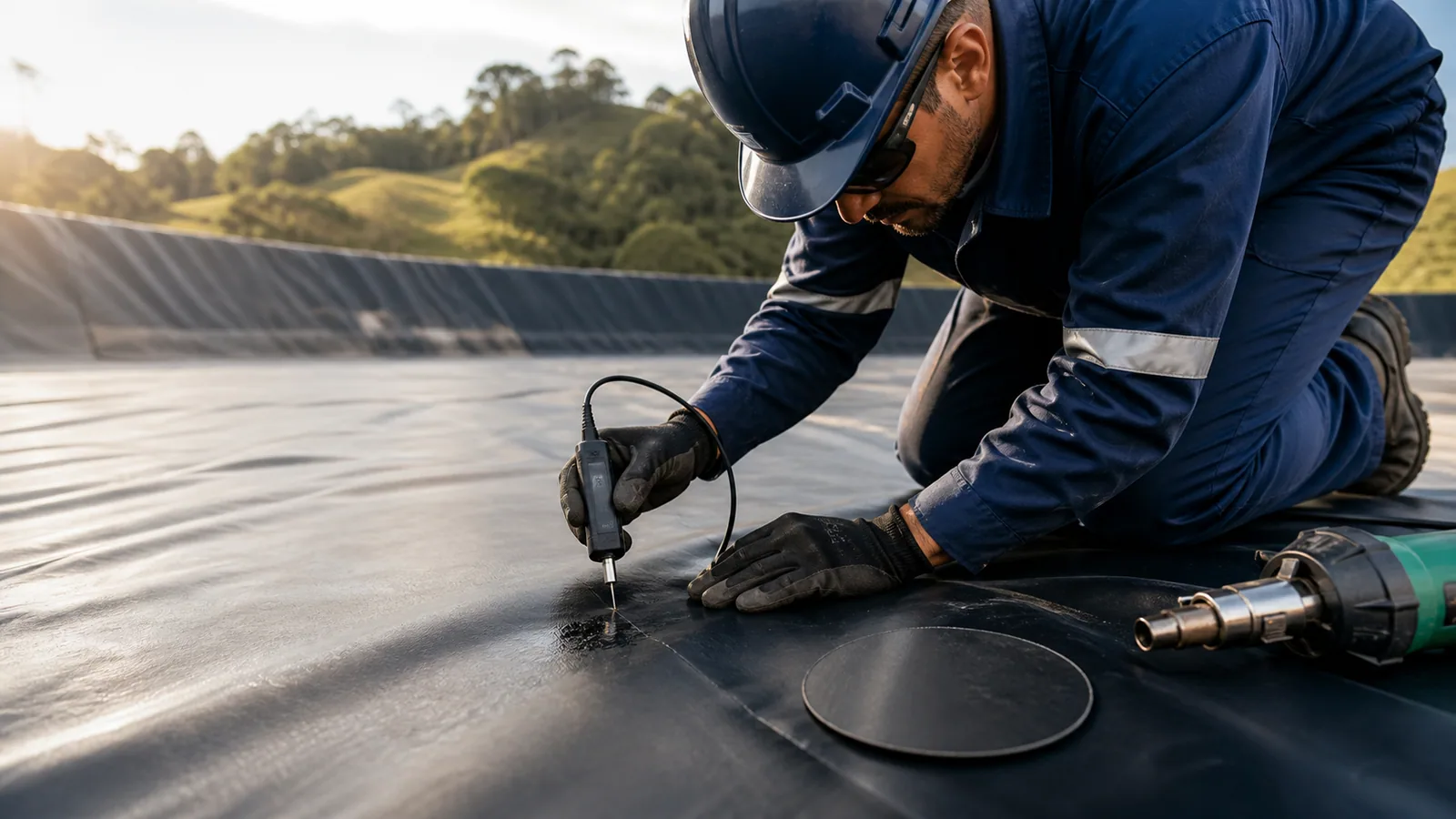
A patch may be appropriate for some defects; others require replacing a section or using a special detail. Polymer, thickness, age, stress, accessibility, and contamination change the solution.
Tape, generic adhesive, or uncontrolled heating are not reliable permanent repairs for HDPE. Heat fusion must be performed by a qualified team on a prepared surface and with a compatible procedure.
Also investigate why the damage occurred: a stone beneath the sheet, equipment, stress at a pipe, settlement, failed protection, or an operating impact. Covering the point without eliminating the cause may shift the problem to an adjacent area.
5. Retest before filling
After repair, perform the applicable inspection and verification test. Update the map and record the material, technician, date, and result. Filling must follow the installation plan, with observation of the repaired point.
The article on geomembrane weld quality control explains why testing, traceability, and acceptance criteria must be established before operation.
What to provide when requesting service
- known material and thickness;
- age and purpose of the installation;
- volume and level history;
- exposed, covered, or submerged condition;
- photographs of panels, welds, pipes, and the external area;
- recent changes, cleaning, or equipment access;
- installation documents and previous repairs;
- fluid hazards and access conditions.
With this information, LJS can evaluate the scope of after-sales service, maintenance, and repairs and prepare the appropriate intervention.
Technical references
- ASTM — catalog of geotechnical engineering standards
- ASTM D7240 — locating leaks in exposed conductive-backed geomembranes
- ASTM D7007 — electrical leak location for covered geomembranes
- U.S. EPA — Construction Quality Management
Public descriptions of these standards help distinguish the methods. Complete operating parameters and procedures must be obtained from the applicable editions and executed by a qualified team.