In brief
- The base must be firm, even, stable, and free from objects that could damage the sheet.
- Water, mud, erosion, and traffic can cause rejection of an area that appeared ready.
- Drainage and venting beneath the liner must be decided before installation.
- Subgrade acceptance must be a formal, documented project hold point.
Much of the risk to a geomembrane develops before the first weld. A base with angular stone, a soft area, or incomplete drainage can concentrate stress and cause damage that only becomes visible when the structure is full.
Therefore, “earthworks complete” is not the same as “subgrade accepted.”
What a ready base must provide
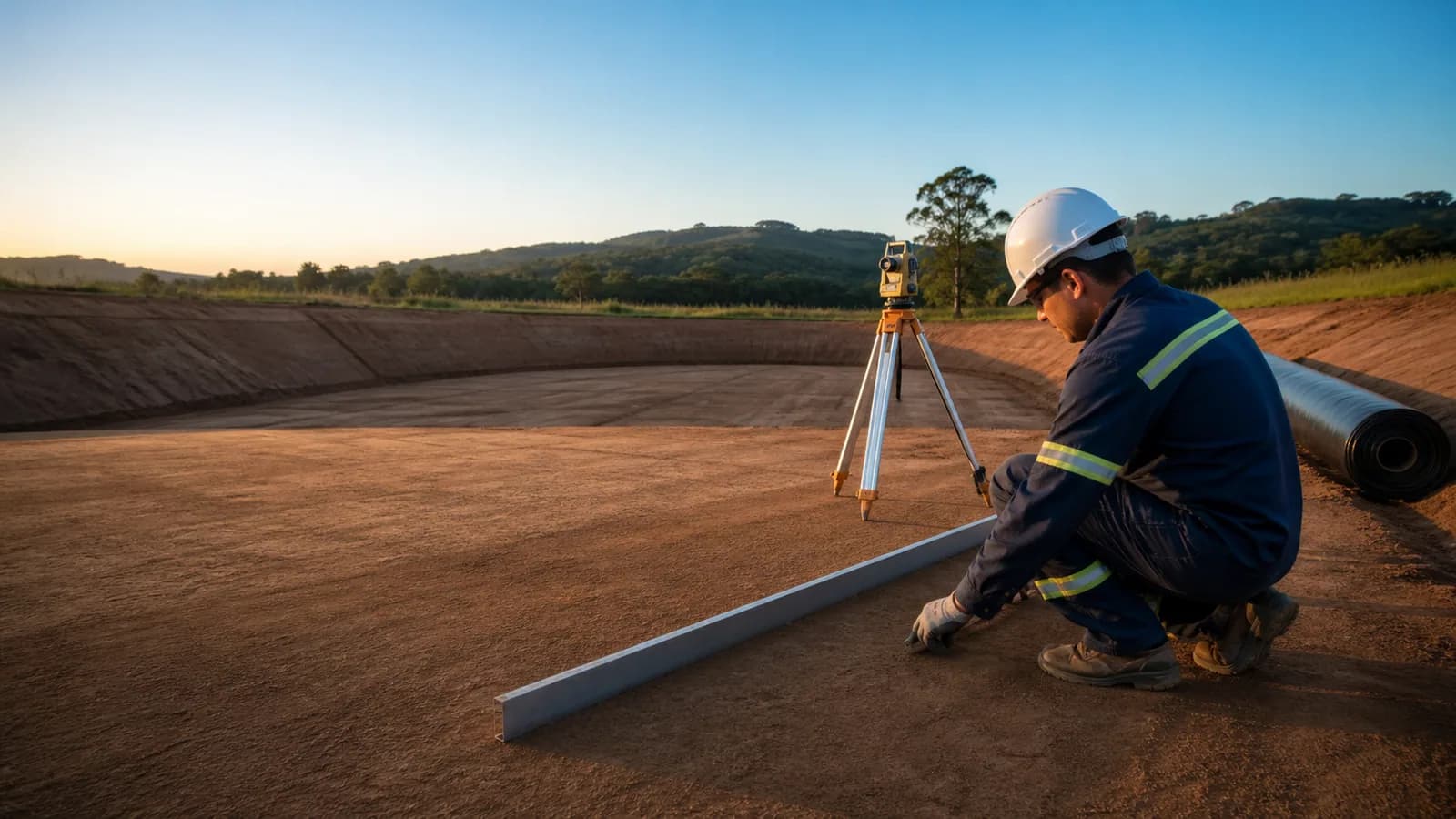
The surface must follow the design geometry, support installation activities, and support the sheet uniformly. Exact criteria for compaction, surface regularity, and acceptable particle size come from the project specification; there is no single recipe for every soil and geomembrane.
During inspection, look for:
- angular stones, roots, metal, debris, and soil clods;
- voids, cracks, erosion, and deep tire marks;
- soft areas, pumping, or signs of settlement;
- standing water, mud, and incompatible moisture conditions;
- abrupt transitions, corners, and radii that do not match the details;
- incomplete anchor trenches and pipe penetrations.
Drainage that will become invisible
Once the geomembrane is installed, correcting what lies beneath it becomes much more difficult. Groundwater, gas, and lateral seepage can generate pressure and uplift the sheet. When the risk requires it, drainage and venting must have a defined path, outlet, and inspection capability.
Surface water must also be diverted so that it does not erode slopes or enter the structure during construction. “Drain” is not a single solution: each flow must have a defined source and destination.
What to do after rain
Heavy rain can form gullies, soften sections, and carry particles onto the base. Even an accepted surface must be reinspected after rain, strong wind, drying, maintenance, or subsequent traffic.
Installing over mud and attempting to correct the situation later increases the risk of weld contamination, wrinkles, uneven support, and mechanical damage.
The hold point that prevents conflict
A clear routine reduces disputes between earthworks and installation teams:
- the earthworks team completes and cleans the area;
- elevations, slopes, transitions, and drains are checked;
- the installer and construction quality team inspect the surface;
- defects are marked and corrected;
- the section is accepted and documented;
- only then are the panels unrolled;
- every altered area is reinspected.
Dated photographs and sketches of accepted sections help maintain traceability.
Do sand or geotextile solve the problem?
A selected soil layer and geotextile may be part of the protective system, but there is no universal sand thickness or geotextile mass. The decision depends on particles, stresses, water, stability, and construction method.
See also when to use geotextile under a geomembrane. No layer should conceal roots, voids, or settlement without addressing the cause.
Checklist before unrolling the panels
- elevations, slopes, anchoring, and transitions checked;
- sharp objects and organic matter removed;
- soft areas corrected;
- surface clean, firm, and free of standing water;
- drainage and venting complete and connected to outlets;
- access and installation sequence defined;
- formal acceptance documented;
- weather forecast compatible with installation.
LJS can review photographs, drawings, the contained fluid, and ground conditions as an initial assessment and define the scope of geomembrane installation. Final release, however, depends on verification of the actual site.
Technical references
- USDA-NRCS — Pond Sealing or Lining, CPS 521
- U.S. EPA — Construction Quality Assurance for Waste Containment Facilities
- U.S. EPA — Subtitle D Technical Training Manual
Quantitative criteria must come from the design, the specification, and the requirements applicable to the project.