In summary
- Side wall enclosures in poultry barns directly control drafts, natural light, and thermal stability.
- Material selection must account for wind resistance, impermeability, ease of sanitization, and UV degradation resistance.
- In conventional barns, curtains provide natural ventilation; in negative-pressure or tunnel-ventilated houses, their primary role shifts to airtight sealing.
- Properly aligned cables, pulleys, winches, and overlaps prevent premature tears and sudden swings in the flock's environment.
In commercial poultry farming, indoor climate management dictates feed conversion rates, weight gain, and flock mortality. The side walls of the barn represent the most dynamic physical boundary in this structure: they must open to exchange stale air or close completely to retain heat during brooding and block wind-driven rain.
A poultry house curtain is not merely a plastic tarp. It is a functional component of the barn's climate control system. Specifying the wrong material, fabric weight, or suspension hardware leads to air infiltration, thermal swings, and accelerated wear under continuous environmental exposure.
Curtain functions in poultry housing
Side curtains fulfill different requirements depending on the flock's growth stage and the building design:
- Heat retention during brooding: in their first weeks, chicks demand higher temperatures and strict thermal stability. Side curtains and internal brooding divider curtains help retain warm air generated by heaters or brooders.
- Ventilation and air exchange control: in naturally or mixed-ventilated barns, adjusting curtain openings from the top or bottom regulates airflow, purging humidity and gases like ammonia and carbon dioxide without creating chilling drafts across the litter.
- Airtight sealing in climate-controlled houses: in tunnel-ventilated (negative pressure) systems, side curtains must ensure an airtight seal so that target static pressure is maintained and fresh air enters exclusively through wall inlets or evaporative cooling pads.
- Weather protection: wind-driven rain can soak litter if curtains have excessive slack, punctures, or insufficient overlap, triggering litter caking and rapid ammonia volatilization.
- Lighting control (dark house): in barns designed for strict photoperiod control, blackout curtains block external sunlight, enabling artificial programming of the flock's circadian rhythm.
Material specification criteria
Poultry curtains face continuous exposure to outdoor weathering on one side and corrosive chemical vapors (such as ammonia) and dust on the inside. Key criteria when selecting the material include:
Tensile and tear strength
The base fabric must withstand lateral forces exerted by strong winds without permanent stretching or tearing along mounting points. Woven reinforced polyethylene or PVC-laminated tarpaulins distribute mechanical stress uniformly.
Ultraviolet (UV) radiation protection
Direct sun exposure degrades conventional polymers, making them brittle within months. The material requires high-grade UV stabilization additives to withstand intense solar exposure cycles without premature flaking or cracking.
Light transmission and blackout properties
- Translucent or semi-translucent curtains: suitable for conventional houses that utilize natural daylight during operating hours.
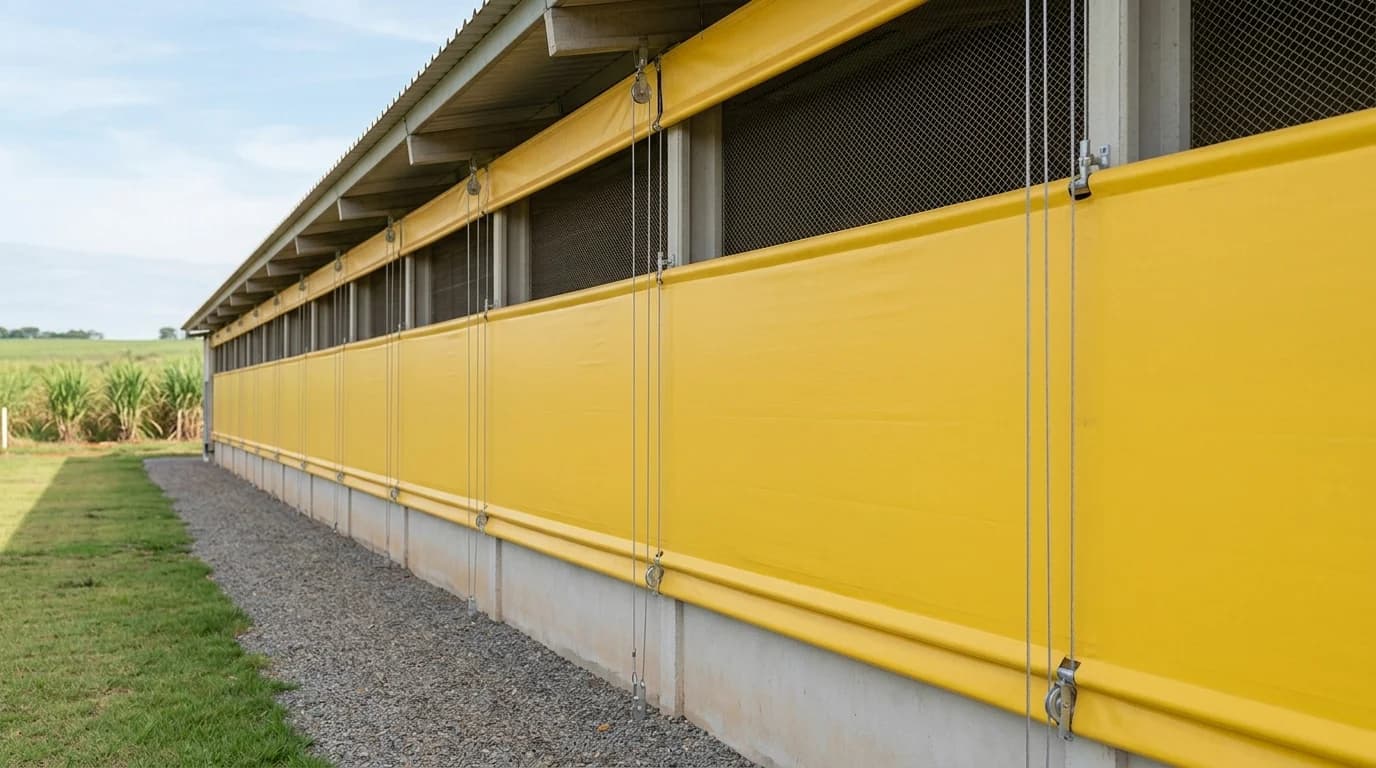
- Yellow or blue curtains: widely used in mixed-ventilation houses, providing visual comfort and diffused illumination.
- Blackout or dual-laminated curtains: vital for dark houses, featuring a reflective light-colored exterior face to deflect solar radiation and a dark interior layer to stop light penetration.
Sanitization and biosecurity
Between flock cycles, housing facilities undergo a sanitary downtime with high-pressure washing and chemical disinfection. Curtains require a smooth, non-porous finish to prevent the buildup of biofilms, molds, or residues that resist sanitation.
Hardware components and drive systems
Even high-grade fabrics will fail prematurely if suspension and tensioning hardware is substandard. The mechanical assembly includes:
- Roll-up conduit pipes or drop cables: responsible for raising and lowering the curtain. Burred pipes or frayed, corroded steel cables create severe friction and tear the fabric.
- Pulleys and winches: nylon or heavy-duty metal pulleys of appropriate diameter reduce friction. Manual winches or automated drive units integrated with climate controllers adjust curtain height accurately.
- Bottom drop and sealing skirts: the lower edge of the curtain must maintain an airtight overlap with the knee wall. This bottom skirt stops drafts near the floor and prevents air leaks in negative-pressure barns.
- Anti-bird wire netting: curtains operate in conjunction with exterior wire mesh required by biosecurity standards, preventing wild birds from entering when curtains drop.
Integration with exterior drainage and gutters
Rainwater shedding from side curtains must be diverted away from the building foundation and knee walls. If roof runoff drips directly onto curtains or pools near the walls, interior humidity rises and structural corrosion accelerates.
Installing agricultural gutters along barn eaves captures roof runoff, protecting side curtains from splashing mud and directing clean water toward drainage ditches or retention reservoirs.
To explore custom side-enclosure solutions for animal housing, review our poultry and swine curtains.
Installation and maintenance best practices
- Tension calibration: avoid loose fabric that billows in the wind, as well as over-tightening beyond design limits that can rip hems and eyelets.
- Preventive cable inspection: replace frayed or rusted cables before placing chicks to prevent accidental drops during hot or freezing weather.
- End-wall sealing: eliminate gaps between curtain ends and corner framing using tight sealing channels, ensuring ventilation air enters only through engineered openings.
- Periodic washing: clean tarps using neutral detergents and registered disinfectants during downtime, avoiding abrasive tools that strip protective laminations.